Ramana Maharishi: Life, Teachings, Self Inquiry, and the Meaning of “Who Am I?”
Introduction
Ramana Maharishi remains one of the most influential spiritual sages of modern India. Revered for his silence, simplicity, and direct teaching, he guided seekers toward a single essential question: Who am I? His teaching was not based on abstract philosophy alone. It was a practical inward path that pointed people away from mental agitation and toward direct knowledge of the Self.
For many readers, Ramana Maharishi is more than a historical saint. He represents a living doorway into peace, self-knowledge, and inner stillness. His central message continues to inspire spiritual seekers across the world because it speaks directly to the root of human suffering and the possibility of lasting inner freedom.
Who Was Ramana Maharishi?
Ramana Maharishi was born Venkataraman Iyer on 30 December 1879 in Tiruchuzhi, Tamil Nadu. At the age of sixteen, he underwent a profound inner awakening after a sudden and intense fear of death. Instead of reacting outwardly, he turned inward and investigated what actually dies. That direct investigation transformed the course of his life and became the foundation of the teaching now known worldwide as self inquiry.
Soon after this realization, he left home and traveled to Arunachala in Tiruvannamalai, the sacred hill that would remain the center of his life and teaching. He first lived in temples and caves, often absorbed in deep silence, and later stayed in places such as Virupaksha Cave and Skandashram before the rise of Sri Ramanasramam at the foot of Arunachala.
Ramana Maharishi Life Story in Brief
A short account of Ramana Maharishi’s life story helps explain why his words still carry such unusual force. After his awakening in 1896, he became deeply absorbed in inner stillness. Over time, visitors began to gather around him, not because he promoted himself, but because his presence had a remarkable effect on those who came near him. Later, an ashram formed around him, and seekers received guidance either through silence or through brief but penetrating answers to spiritual questions.
His mother and younger brother eventually joined him in Tiruvannamalai. After his mother’s death in 1922, the site of her tomb became the center of Sri Ramanasramam, where Ramana Maharishi lived until his death in 1950. During these years he was not merely a silent recluse. He was also involved in ordinary ashram life and practical activities, while remaining rooted in the same inner clarity for which he became known.
The Heart of Ramana Maharishi Teachings
Among the many Ramana Maharishi teachings, one stands above the rest: turn attention inward and trace the sense of “I” back to its source. This is the essence of Self-Enquiry. According to his teaching, the “I” thought is the first movement of the mind. Other thoughts follow only after that primary sense of individuality arises. Therefore, rather than fighting every passing thought one by one, he advised seekers to examine the one to whom all thoughts appear.
In practical terms, when a thought arises, the instruction is to ask, “To whom has this thought arisen?” The answer is, “To me.” Then the deeper question follows: “Who am I?” By repeatedly turning attention back to the root sense of “I,” the mind gradually becomes quiet and returns to its source.
This is why Ramana Maharishi and the question “Who Am I?” remain so closely linked. His teaching is direct, simple, and profoundly transformative when practiced sincerely.
What Does “Who Am I?” Mean in Ramana Maharishi’s Method?
For Ramana Maharishi, “Who Am I?” is not a request for a mental or verbal answer. It is not asking for a biography, identity, role, or belief. It is an inward method meant to dissolve false identification.
The question is used to expose the assumed self, the one that says, “I am this body,” “I am this mind,” or “I am this personal story.” His method directs attention away from objects such as thoughts, memories, emotions, and perceptions, and toward the subject that experiences them.
Instead of studying what appears in consciousness, the seeker studies the one who claims experience. When attention remains with that felt sense of “I,” rather than following thought after thought, the egoic structure begins to weaken and the deeper Self stands revealed.
This is why the short text Who Am I? is often treated as the most accessible gateway into his teaching.
Ramana Maharishi Self Inquiry, Step by Step
The practical side of Ramana Maharishi self inquiry can be expressed simply.
When a thought arises, do not chase it. Ask, “To whom has this thought arisen?” When the answer comes, “To me,” ask, “Who am I?” Then rest attention in the sense of “I” itself, without moving outward toward new thoughts or distractions. Through repetition, the mind learns to sink back into its source.
This does not mean forcing the mind violently into silence. It means refusing to feed distraction. The practice is subtle and inward. The goal is not conceptual mastery, but direct awareness of the source of consciousness itself.
Ramana Maharishi also acknowledged that devotion, surrender, meditation, and breath regulation can support this inward turning. Still, Self-Enquiry remains the path most closely associated with him.
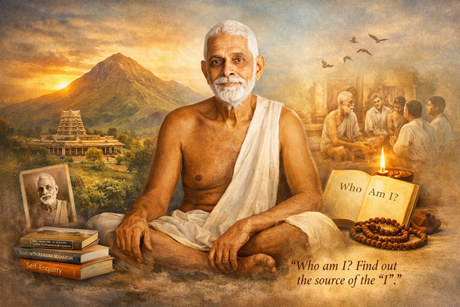
Ramana Maharishi Books That Introduce His Philosophy
Readers searching for Ramana Maharishi books often begin with a few key texts. The most important starting point is Who Am I?, since it presents the teaching in a concise and practical question-and-answer form.
Other well-known books connected with his teaching include Self-Enquiry, Thus Spake Ramana, and Talks with Ramana Maharishi. These works help readers approach his message from different angles, whether through direct instruction, conversations, or reflective insights.
For beginners, a useful order is to start with Who Am I?, continue with practical teachings on self inquiry, and then move into longer dialogues and recollections. That sequence helps readers understand that Ramana Maharishi’s teaching is not merely philosophical. It is meant to be practiced.
Ramana Maharishi Quotes and Why They Endure
Many people first encounter him through Ramana Maharishi quotes. His sayings are widely shared because they compress deep insight into very simple language. One of the most remembered lines associated with him is: “Where can I go? I am always here.”
The enduring power of Ramana Maharishi quotes lies in their clarity. They do not rely on complexity or ornament. They redirect attention. Even when read outside a formal spiritual setting, they challenge the restless habit of identifying with passing thought and emotion.
In that sense, his quotes serve as living reminders of his central teaching: the peace people seek is not created from outside, but uncovered within.
Ramana Maharishi Ashram and the Importance of Arunachala
Any serious account of Ramana Maharishi must include Arunachala and Sri Ramanasramam. Arunachala was not merely the place where he lived. It was central to his spiritual life from the moment he felt its pull as a young man.
After reaching Tiruvannamalai, he remained there for the rest of his life. Over time, the community that formed around him became Sri Ramanasramam, which developed at the base of Arunachala around his mother’s samadhi.
For devotees and spiritual travelers, the Ramana Maharishi ashram remains deeply meaningful because it represents a living continuity of his presence and path. For general readers, it stands as a historical reminder that even the most inward of teachings can transform a physical place and draw seekers from around the world.
Ramana Maharishi Photos and Public Fascination
Search interest in Ramana Maharishi photos reflects more than simple curiosity. His photographs are often described as calm, direct, powerful, and deeply still. Many admirers feel that even his image carries something of the silence for which he became known.
This fascination is understandable. Ramana Maharishi taught largely through presence, not performance. His photographs often function as reminders of inwardness, steadiness, and peace. Whether one interprets that spiritually or psychologically, the visual legacy remains an important part of his continued relevance.
Ramana Maharishi Death and Lasting Legacy
Ramana Maharishi died on 14 April 1950 after suffering from cancer in his final years. Even during illness, he remained rooted in the same clarity and detachment that defined his life and teaching.
His influence continued to grow after his death, both in India and internationally. Visitors, writers, and devotees helped introduce his teachings to readers across the world. Yet his enduring legacy does not rest only on historical reputation. It rests on the timeless freshness of a path that remains radically simple: know the one who experiences, and confusion begins to fall away.
Why Ramana Maharishi Still Matters Today
In an age of constant distraction, Ramana Maharishi’s message feels especially relevant. He did not offer endless theories, external identity, or spiritual complexity. He pointed directly to the root of experience itself.
For people exhausted by mental noise, this is not merely ancient wisdom. It is a practical invitation to pause, turn inward, and examine the one who says “I.” That is why interest in terms such as Ramana Maharishi teachings, Ramana Maharishi books, Ramana Maharishi quotes, and Ramana Maharishi Who Am I remains strong.
His appeal crosses devotional, philosophical, and meditative audiences because the core question he raised belongs to every human being.
Conclusion
Ramana Maharishi’s life was outwardly simple, but inwardly revolutionary. From his awakening at sixteen to his years at Arunachala and Sri Ramanasramam, he offered one of the clearest spiritual teachings of the modern era: seek the source of the “I,” and truth reveals itself.
His life story, books, quotes, self inquiry method, and ashram all point back to that same center. For this reason, Ramana Maharishi is not remembered only as a saint of the past. He remains, for many, a present guide to peace, self-knowledge, and freedom.
FAQ
What is Ramana Maharishi best known for?
He is best known for teaching Self-Enquiry, especially the inward question “Who am I?”, as a direct path to Self-realization.
Where was Ramana Maharishi born?
He was born in Tiruchuzhi, Tamil Nadu, India, on 30 December 1879.
What is the meaning of Ramana Maharishi’s “Who Am I?”
It is a practical method of tracing the sense of “I” back to its source, rather than answering the question intellectually.
Where is Ramana Maharishi Ashram?
Sri Ramanasramam is located at the foot of Arunachala in Tiruvannamalai, Tamil Nadu.
Which Ramana Maharishi books should beginners read?
Most beginners start with Who Am I?, then continue with Self-Enquiry, Talks with Ramana Maharishi, and related teaching collections.